
Practical Musicianship Training
Conventional training in practical musicianship, keyboard harmony and aural skills are often onerously theoretical and slightly terrifying. This training is very different. It is playful and it really is PRACTICAL.
Music is real. It's something you can understand, feel, or say. Training yourself to grasp its principles and elements in a simple way shapes how you listen, and how you respond in real time — on your instrument, in your voice, and in your whole body. So this training is concrete and full of feeling.
Rhythmic Fluency
Rhythmic time is not measured in fixed durations. It is a stable, flexible structure that we inhabit. Musical fluency begins with rhythm — not as an external stricture to follow, but as something that we feel inwardly.
This involves:
- a direct sense of the nested cellular structure of metre
- an awareness of how rhythmic figures (rhythm cells) fit together relationally within that matrix
- feeling the inner flow that moves your body freely while remaining fully grounded
Through the unfolding rhythmic matrix, structure gives rise to a particular kind of feeling — a sense of movement that can be experienced as poetry, or as a form of unfolding storytelling. This is a quality that is often overlooked, or even resisted, because it feels so simple, even childlike — carrying a sense of innocence and clarity that sits outside more performative or sophisticated conceptions of rhythm. And yet this is the foundation if musical meaning, the essence of fluency.
The key is to feel where you are, while simultaneously knowing where you are within the structure of musical groove as it unfolds. Rather than treating rhythm as a fixed grid to follow, it becomes a structured field of experience or expression — one in which musical thought emerges and moves freely.
Aural Fluency
At the heart of musical understanding is the ability to hear clearly. But audiation is a very overcooked idea. Inner hearing does not require imagining the sound. It is vital that we listen not in advance or in retrospect, but in the present, as the music unfolds. And this is not audiation in the conventional sense — internally generating or manipulating imagined sound is not the primary skill. Anyone can do it! Instead, you need a skill that develops through practising something more direct:
- feeling tonal and rhythmic relationships and connections naturally as they happen in real time
- allowing perception and understanding to arise without thinking
At the same time, this felt experience is then grounded in solid structure. As relationships are perceived, they are also understood in context — located within the stable structures of the rhythmic matrix and the tonal map. The combination is essential:
- feel what is happening
- know precisely what it is
- and where it is within the whole
Only then is hearing reliable and usable in real time. It is not the accumulation of complex recognised elements, but the development of a connected, relational awareness that directly informs musical action.
Harmonic and Melodic Fluency — Keyboard Harmony
To think in music, tonality must be experienced as a structured whole. At any given moment, there is a sense of place — a particular position within the tonal map. Each place within the stable map is understood as a harmonic block: a stable point of reference, centred around a root or tonal centre.
From this fixed position, tonal material may take different forms.
It may be:
- compressed, as harmonic structures
- or extended, as melodic lines
But in both cases, the underlying reality is the same: harmony and melody are both shapes unfolding within a stable tonal structure. Fluency lies in sensing this directly. Again, we must:
feel the relationships as they form
- know what and were they are within the tonal map
- These two aspects — feeling and knowing — can become inseparable.
Understanding does not come from assembling chords or analysing melodic figures in terms of abstract intervals, it arises from recognising how musical shapes are situated within an unchanging structural field —
and the skill of navigating that field in real time. The keyboard map provides a clear and consistent representation of this structure, allowing what is heard and felt to be seen and understood simultaneously and the perfect bridge to true musical literacy.
Musical Shapes
Shapes are like words. They exist at the meeting point of the two axes of rhythm and tonality. Musical shapes in the rhythmic matrix are musical thought. Musical shapes are simply rhythm cells, appearing in the unfolding matrix weaving through tonal blocks, situated within the map
Shapes are recognisable units of musical meaning that can be felt and known, and therefore understood, and expressed. These shapes are not fixed objects to be memorised but more like living forms:
- flexible
- relational
- and responsive to context
The MusicallyFluent Model
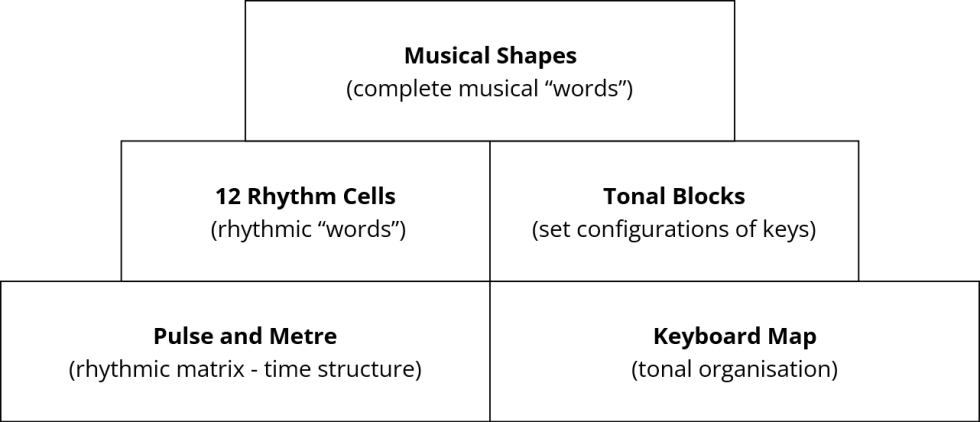
Musical Skills — Musical Fluency
Understanding is only meaningful when it leads to action or response. Fluency shows itself in the ability to respond:
- to say musical shapes in the matrix
- to improvise, read, write or repeat memorised music with total clarity
- to express clearly and precisely — to move from intention to sound without hesitation
It cannot be repeated too often that this is not based on memorised material or rehearsed patterns. It emerges from a direct connection between hearing, understanding, and the action of communication —
so that music becomes a living, responsive language.
Psychological Practice
All of this depends on the quality of your moment-by-moment attention. Without training the skill of focus, knowledge does not become unreliable musical skill. But focus is only possible if we let go of the ego's desire for results, for approval and control.
The work therefore includes:
- learning to focus without tension
- allowing the body to respond without interference
- letting go of self-monitoring while remaining clear and precise
The principle of focus and letting go is a practical discipline and the core teaching.
Integration
These are not really discrete, separate skills. They are just different expressions of a single underlying capacity:
the ability to think in music. This is feeling and knowing simultaneously. We feel what we hear and know what it is (vocabulary) and where it is happening in the tonal-rhythmic structure (syntax). When developed in this way, musicianship becomes:
- clearly understood
- stable
- flexible
- expressive
- without strain
This is the practical foundation of MusicallyFluent.